

Human Capital
The Group’s human capital strategy is to create an environment where each employee can act autonomously, as they aspire to “Trust for a Flourishing Future,” take on the challenge of creating new value, and play an active role. This approach enables them to showcase their unique skill sets and contribute to the organization’s overall strength.
To sustainably maintain and strengthen our human capital in order to realize our management strategy, the Group is building a diverse, specialized workforce to support our extensive range of functions and business portfolio. Our focus is on human resource development and providing career development support, with the objective of enabling each employee to evolve into an “autonomous career-type talent” who considers their future aspirations and takes action to achieve them.
We will enhance our personnel system, evaluation processes,placement procedures, promotion management,and human resource development programs in a flexible manner. Our objective is to establish a work environment in which each employee can contribute meaningfully. This environment will provide fair and equitable support based on career stage and life events, thereby maximizing each individual’s capabilities to contribute to the organization.Through these initiatives, we are building a talent pool that supports the execution of our business strategy and drives the enhancement of corporate value.

Diversity, Equity & Inclusion
Guided by SuMi TRUST Group's management principles (mission), we seek to harness the diversity and creativity of each and every individual - the very concept behind diversity, equity and inclusion - and our Basic Policy for Personnel Affairs Management aims to add value to the organization by making full use of the diversity and creativity of all employees. The business model of a trust bank group should aim to offer added value to its clients by leveraging the breadth of diversity throughout the organization. While we have always believed in respecting diversity as an organization, we consider it vital that our employees reaffirm the strengths of the Group so that we can continue to enhance our diversity. SuMi TRUST Group and SuMi TRUST Bank have each established a Diversity, Equity & Inclusion Office (D& Office) within the Human Resources Department. SuMi TRUST Bank's DE&I Office comprises dedicated employees from the Human Resources Department and business supervising departments. In addition to promoting the diversification of work styles for individual employees, the DE&I Office implements measures that best suit the situation of each business with the aim of enhancing corporate value.
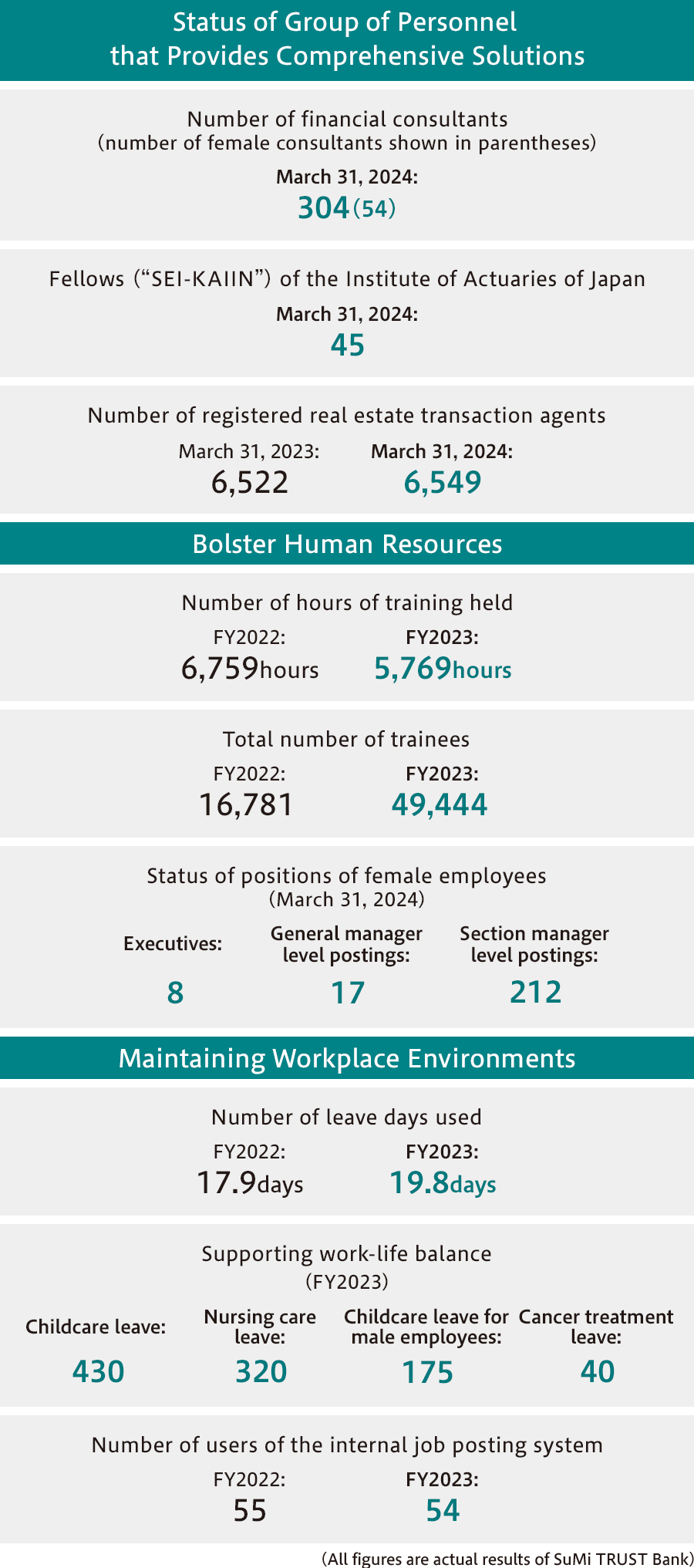
Bolstering Human Resource

(1) Skill-Raising Human Resource Assignment and OJT*
SuMi TRUST Group views OJT as the foundation for human resource development. We also focus on assigning employees to roles that awaken their passion for growth and allow them to display their abilities to the maximum extent. In fiscal year 2018, SuMi TRUST Bank introduced a program that enables younger employees to experience multiple work domains within a fixed period. We are also advancing initiatives such as a trust internship program aimed at developing human resources who possess a "high degree of expert knowledge in trust operations" and a "deep understanding of the fiduciary spirit."
*OJT: On-the-Job Training. OJT is a process whereby workplace supervisors and senior employees teach subordinates the knowledge, skills, and duties required of them via their daily tasks.
(2) Enhancing Training and Other Off-JT* Programs
SuMi TRUST Group has established the TRUST University to offer group training with the objective of improving employee business skills and management abilities. In addition, many opportunities in the self-development programs encourage employees to continue improving their skills. The company's president serves as the dean of TRUST University, while the executive officer in charge of the Human Resources Department and an external expert serve as vice deans. The university is a group-wide program that also receives advice regarding management from the graduate school of Hitotsubashi University. From FY2020 we plan to turn TRUST University into a platform through which employees can discover their own appetite for learning, connect with others around them, and learn from each other. We also intend to enhance the content offered and strengthen the university's infrastructure so that it is more user-friendly.
*Off-the-job training: Workshops, training, and other methods are utilized to provide employees with the knowledge and skills that cannot be acquired through OJT.
(3) Enhancing Leadership
SuMi TRUST Bank offers a program to develop next-generation executive candidates in cooperation with Hitotsubashi University's Graduate Programs. Candidates receive instruction on the values, general liberal arts knowledge, and MBA elements they need for management, and through sessions and courses, they complete the program by presenting a proposal to senior executives. The Bank also provides a leadership development program for female employees to step up to management through various rank-based training. After the employees complete their training, operations are conducted such as providing them with opportunities to practice what they have learned during training in a variety of environments, primarily through promotion and job rotation.
(4) Fair Evaluations and Treatment
Fair and just evaluations and treatment in accordance with abilities, roles, and results form the basis of SuMi TRUST Bank's performance evaluation system. The system used is based on a participatory model, in which employees communicate closely with their supervisors on a daily basis to establish and review specific goals. The process focuses not only issues related to the performance of duties, but formulates and provides feedback on future career development. Also, as a means of obtaining a multifaceted view of personnel, we have introduced an anonymous survey through which subordinates and others can rate the day-to-day management actions of line managers (general managers, deputy general managers, section managers, etc.). By conducting this survey, we can encourage management action reform and foster a culture of interactive communication.
Health Management
Health Management Declaration
Sumitomo Mitsui Trust Group believes that “well-being of employees" is of utmost importance in order to practice “Trust for a flourishing future."
The goal of health management is to create a virtuous circulation in which the healthy and energetic work of each and every employee creates value for customers and society through the Group's services, and this in turn makes employees feel fulfilled.
We will practice health management while sustaining reforms in work styles from the following perspectives:
- Support for health promotion through health investment measures
- Achieve diverse work styles and work-life balance
- Provide opportunities for employees to work and grow in a rewarding environment
July 1, 2026
Sumitomo Mitsui Trust Group, Inc.
Director, President & CEO
Kazuya Oyama
(1) Health Management
Mental and physical health form the basis of well-being and drive value creation. At Sumitomo Mitsui Trust Bank, the Chief Human Resources Officer (CHRO) leads our commitment to providing a safe, secure, and comfortable work environment. We support each employee in raising health awareness and maintaining and improving their health. Through close collaboration with the Society-managed health insurance, the health promotion center (in-house clinic) , and the Human Resources Department, we promote health management initiatives aimed at creating an organization where employees can work energetically, maintain good health, and maximize their capabilities and performance.
Health Management Promotion Structure (Sumitomo Mitsui Trust Bank)

 (206KB)
- Identifying and Preventing Health Risks and Creating a Safe Workplace Environment
-
Sumitomo Mitsui Trust Group has established occupational health and safety management systems at each of its offices and branches. The Health Committee serves as a platform for ongoing dialogue on workplace environments and health-related issues. We also work to identify health risks and prevent occupational accidents through workplace inspections, building and facility checks, and workplace environment monitoring. We address issues identified through these activities with appropriate improvement measures to help us maintain and enhance a safe, healthy, and comfortable workplace environment.
- Initiatives for Health Maintenance and Promotion
-
In recognition of its efforts to support and enhance the physical and mental health of all employees, the Group has been certified as a “White 500 company under the Outstanding Organizations of KENKO Investment for Health Program” for nine consecutive years. To improve health literacy, we provide educational opportunities, such as study sessions for senior management, training programs for management, seminars for employees in charge of health-related initiatives, and e-learning courses. Regarding physical health, we ensure that all employees undergo annual health examinations and provide individual guidance to encourage employees in need of medical attention to consult with doctors. Furthermore, to improve the workplace environment by preventing exposure to secondhand smoke and supporting employees’ health, we have implemented a smoke-free policy across all our facilities. To support mental health, we conduct seminars and have counseling rooms where clinical psychologists provide counseling to help employees work with confidence and peace of mind. In recent years, we have strengthened our support for women’s health to create an inclusive workplace where diverse talent can thrive.
- Promoting Health Management Based on KPIs
-
The Group has established presenteeism, absenteeism, and employee engagement as KPIs for its health management initiatives. Through activities such as the Health Committee, workplace inspections, facility checks, health examinations, and stress checks, we identify health-related issues and risks. We then implement measures to maintain and improve employee health, as well as initiatives to enhance the workplace environment. Finally, we assess the effectiveness of these measures by monitoring changes in relevant KPIs. Based on the results of these assessments, we continuously review and strengthen our initiatives, further advancing our efforts to improve employee health and organizational vitality.
| Period | Health promotion events and initiatives (including initiatives conducted exclusively by Sumitomo Mitsui Trust Bank) |
|---|---|
| FY2015 and earlier |
|
| FY2016 |
|
| FY2017 |
|
| FY2018 |
|
| FY2019 |
|
| FY2020 |
|
| FY 2021 |
|
| FY 2022 |
|
| FY 2023 |
|
| FY 2024 |
|
| FY 2025 |
|
| FY 2026 |
|
| Indicator | FY2021 | FY2022 | FY2023 | FY2024 | FY2025 |
|---|---|---|---|---|---|
| Annual health examination rate*1 | 100.0% | 99.9% | 100.0% | 100.0% | 100.0% |
| Follow-up medical examination rate | 72.6% | 79.2% | 80.1% | 80.4% | 63.8% |
| High-risk employee management (continuation of treatment) rate*2 | - | - | 78.6% | 84.1% | 84.5% |
| Healthy weight maintenance rate (BMI 18.5 to less than 25) | 68.4% | 67.4% | 66.2% | 64.3% | 65.4% |
| Specific health examination implementation rate | - | 98.6% | 98.5% | 98.5% | - |
| Specific health guidance implementation rate | - | 23.4% | 24.7% | 51.2% | - |
| Percentage of employees with regular exercise habits | 17.9% | 18.9% | 21.9% | 23.2% | 23.2% |
| Smoking rate | 11.1% | 11.2% | 10.9% | 10.6% | 10.3% |
| Percentage of employees receiving adequate rest through sleep | - | - | 56.5% | 56.3% | 56.7% |
| Stress check participation rate | 93.6% | 92.3% | 91.0% | 91.3% | 91.7% |
| Overall health risk score (national average = 100) | 94 | 90 | 89 | 88 | 88 |
| Percentage of high-stress employees | 9.6% | 9.4% | 9.2% | 9.8% | 8.9% |
| Status of leave due to illness or injury (average number of days absent and on leave)*3 | - | - | 2.98 days | 2.84 days | 3.00 days |
| Completion rate of health management e-learning programs | - | - | 93.4% | 92.5% | 93.8% |
| Satisfaction level with health management initiatives*4 | - | - | 75.0% | 77.9% | 77.7% |
| Number of Cradle service users*5 | - | - | 586 | 926 | 1,458 |
| Company-wide walking event participation rate*6 | - | - | 24.4% | 30.6% | 25.3% |
| Enrollment rate in the "Vitality benefits program" health promotion tool*7 | - | - | - | 52.4% | 63.3% |
| Number of occupational accidents | - | - | 127 | 128 | 122 |
| Number of fatal occupational accidents | - | - | 0 | 0 | 0 |
| Lost workday rate due to occupational accidents*8 | - | - | - | - | 0.02% |
- *1In addition to the statutory health examination items, optional items such as various cancer screenings and fundus examinations have been added. Financial assistance for optional items for FY2025 was ¥39.75 million.
- *2Among those who underwent annual health examinations and completed the medical questionnaire, the number of employees currently receiving treatment for hypertension divided by (the number of employees currently receiving treatment for hypertension + the number of employees with hypertension who are not receiving treatment).
- *3Total number of days of absence and leave attributable to illness, aggregated based on records from the internal attendance management system and medical certificates, divided by the number of full-time employees.
- *4Percentage of employees who responded "Very satisfied" or "Satisfied" to the question, "Are you satisfied with the health management initiatives?" among those who completed the company-wide e-learning program on Health Management Initiatives.
- *5As of March 31, 2026. Number of registered users of the Cradle service, which offers employees online seminars focused on women’s health issues, gynecological consultation coupons, and other related support services. The total number of registered users across Sumitomo Mitsui Trust Group, including Sumitomo Mitsui Trust Bank and its subsidiaries and affiliated companies, was 2,228.
- *6Held twice annually (spring and autumn). Eligible employees represented 98.8% of all employees in FY2025. Participation rate among eligible employees.
- *7As of March 31, 2026. Eligible employees represented 97.7% of all employees. Participation rate among eligible employees. Program cost: \43.37 million (actual results as of October 2025).
- *8Total number of workdays lost due to occupational accidents, divided by the number of business days.
| Indicator | FY2021 | FY2022 | FY2023 | FY2024 | FY2025 | FY2030 Targets |
|---|---|---|---|---|---|---|
| Presenteeism*1 | - | 20.6% | 20.6% | 23.1% | 17.2% | 10% or less |
| Absenteeism*2 | 1.8% | 2.0% | 2.1% | 2.0% | 2.1% | ‐ |
| Of which, due to mental health issues | 1.6% | 1.5% | 1.7% | 1.7% | 1.6% | 1.3% |
| Engagement*3 | 57.6 points | 60.0 points | 60.0 points | 60.3 points | 61.1 points | 65.0 points |
- *Measurement method, number of respondents, and response rate
-
*1Based on the University of Tokyo’s single-item presenteeism measure. Employees were asked: “Assuming that your job performance when not affected by illness or injury is 100%, what percentage of that performance have you achieved over the past month?” The score was calculated as “100% minus the reported percentage” and represents the average for all employees. Measured based on responses from 12,068 of 13,076 eligible employees (response rate: 92%) in FY2025. Lower scores indicate better performance.
*2Percentage of employees who took long-term leave or were absent from work for one month or longer due to physical or mental health issues (221 employees out of 10,361 full-time employees in FY2025). Lower values indicate better performance.
*3Work engagement. Average score for “Engagement” in the employee survey, calculated as the average of six questions covering topics such as job satisfaction and motivation (out of 100 points) across all employees. From FY2025, the survey questions used for calculation were narrowed from 10 to 6. As a result, historical scores have also been recalculated and restated using the same methodology to ensure comparability. Measured based on responses from 12,068 of 13,076 eligible employees (response rate: 92%) in FY2025. Higher scores indicate better performance.
(2) A Culture That Fosters a Rewarding and Fulfilling Working Environment
Our group is committed to fostering a culture that encourages both challenge and continuous learning. We aim to provide every employee with meaningful opportunities to grow, thrive, and find fulfillment in their work.
At Sumitomo Mitsui Trust Bank, we continuously host the “Branch Manager Academy,” where branch managers themselves serve as instructors, sharing their experiences and insights. In addition, we actively promote employee communication through initiatives such as one-on-one meetings, supporting individual growth and ambition.To ensure the effectiveness of these efforts and amplify employee voices, we have implemented tools such as employee awareness surveys and pulse surveys as a mechanism to convey the voices of employees to the top management and management levels.
In fiscal 2025, as the culmination of our 100th anniversary initiatives, we further strengthened our culture of challenge by holding the “Action Challenge Award”—a company-wide, employee-participatory event where employees presented their own bold ideas and were recognized for their efforts.